
How much fuel does idling cost a fleet? Real numbers from six fleets
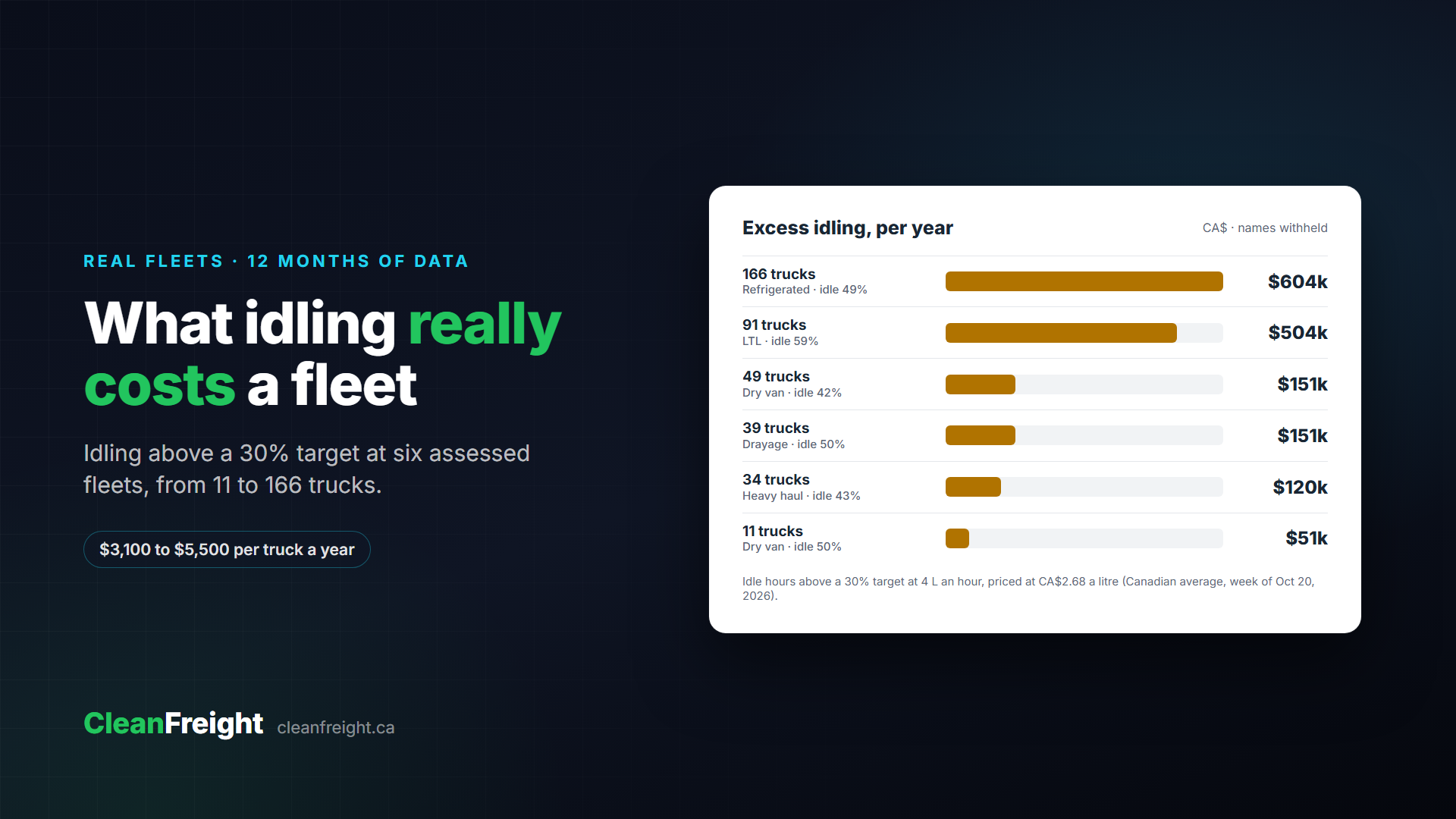
Six real fleets, from 11 to 166 trucks, and what their idling above a 30% target costs in fuel each year: from about $51,000 to $604,000.
Ask a fleet owner how much idling costs them and the honest answer is usually "some, but I'm not sure how much." Idling is easy to see one truck at a time and hard to add up across a fleet and a year.
So here are real numbers. Below are six fleets we have assessed, of different sizes and types, each measured over 12 months of their own telematics data. For each one we looked at idle hours above a 30% idle target, turned them into litres at 4 litres an hour, and priced them at CA$2.68 a litre (Canadian average, week of Oct 20, 2026). All dollar figures are in Canadian dollars.
This is idling only. It does not include the other big leak, the fuel-economy gap between trucks doing the same work.
Six fleets, six idle bills
An 11-truck dry van fleet
This small general freight carrier idled 50% of its engine time. The idling above target came to about $51,000 a year, or about $4,700 per truck. That was 2.5% of all the fuel it bought. For an 11-truck operation, that is real money.
A 49-truck dry van fleet
Also hauling general freight, this fleet idled 42% of its engine time, the lowest of the six but still well above target. The excess came to about $151,000 a year, roughly $3,100 per truck, or 3.1% of its fuel.
A 39-truck drayage fleet
Drayage trucks often spend long stretches waiting for containers. This fleet idled 50% of its engine time, and the excess was about $151,000 a year, or about $3,900 per truck. That idling was 8.3% of all the fuel the fleet bought, by far the highest share of the six.
A 34-truck heavy-haul fleet
This fleet moves heavy equipment and idled 43% of its engine time. The excess came to about $120,000 a year, roughly $3,500 per truck, or 2.5% of its fuel.
A 91-truck LTL fleet
This general freight LTL fleet idled 59% of its engine time, meaning its trucks spent more time idling than driving. The excess came to about $504,000 a year, roughly $5,500 per truck, the highest per-truck figure of the six. That was 3.2% of its fuel.
A 166-truck refrigerated fleet
Hauling food and grocery, this fleet idled 49% of its engine time. With 166 trucks, the excess added up to about $604,000 a year, roughly $3,600 per truck, or 2.7% of its fuel.
What the six have in common
Every one of these fleets idled between 42% and 59% of its engine time. Every one was paying roughly $3,100 to $5,500 per truck a year for idling above target. And none of it ever showed up as a single line on a fuel bill.
As a share of total fuel, excess idling ran from 2.5% to 8.3%. That can sound small until you remember it is coming off one of the biggest bills the fleet pays, every year.
What a 30% idle target means
A 30% idle target means idling up to 30% of a truck's engine time is treated as normal. Waiting at docks, warming up in winter, keeping the cab comfortable on a break: some of that is simply the job. Only the hours above 30% count as excess.
Here is a simple example. Say a truck runs its engine 2,000 hours a year and idles for 1,000 of them, which is 50%.
- The target allows 30% of 2,000 hours, or 600 idle hours.
- That leaves 400 hours of excess idling.
- At 4 litres an hour, that is 1,600 litres.
- At CA$2.68 a litre, that is roughly $4,300 a year, for one truck.
Thirty percent is a fair starting point for most fleets, not a rule. Some set a tighter target because of the work they do; others need more room for long waits or cold climates. In an assessment, the fleet sets the target, and every figure follows from it.
Why idling hides in plain sight
If idling costs this much, why do so many fleets live with it? A few reasons come up again and again:
- It shows up as hours, not dollars. Telematics systems report idle time well. But "50% idle" does not feel urgent the way "$151,000 a year" does.
- It is spread across every truck and every day. No single truck or week looks bad enough to act on.
- Some idling is necessary. Because a fair amount is normal, it is hard to tell where normal ends without a clear target.
- Nobody owns the total. Drivers see their own truck, dispatch sees loads, and the fuel bill arrives as one number.
The data to fix this already exists in most fleets. What is usually missing is a year of it added up, compared with a sensible target and priced truck by truck.
How to start
The first step is knowing your own number, not an industry average. Which trucks idle the most, how many dollars that is, and how it compares with fleets that do the same kind of work as yours.
The Fleet Fuel Waste Assessment works that out from 12 months of your own telematics data. It prices your excess idling at your idle target, adds the fuel-economy gap between your trucks, and names the 10 trucks to look at first, with plain reasons. Connect Samsara, Geotab, Motive or ISAAC and most reports are ready within an hour.
Try a quick estimate for your fleet, then decide: see what your fleet could recover. Fleets in the United States can use the US site, with pricing in US dollars: cleanfreight.io/fuel-waste-assessment.
Examples are real fleets from Clean Freight fuel assessments, with names withheld. Idling above a 30% idle target at 4 litres an hour, priced at CA$2.68 a litre (Canadian average, week of Oct 20, 2026).
One-time report
See what your own fleet is wasting
A Fleet Fuel Waste Assessment turns 12 months of your telematics data into one report: how much fuel is recoverable, where it goes, and the 10 trucks to fix first. CA$500, one time.
Join the platform and get CA$100 back. Subscribe to the CleanFreight platform within 30 days of your report and CA$100 of what you paid for the assessment comes off your first platform invoice.