
How Trucking Fleets Can Reduce Diesel Costs
Learn how trucking fleets can reduce diesel costs by using existing telematics data to identify idle waste, non-idle fuel waste, underperforming trucks, and recoverable savings.
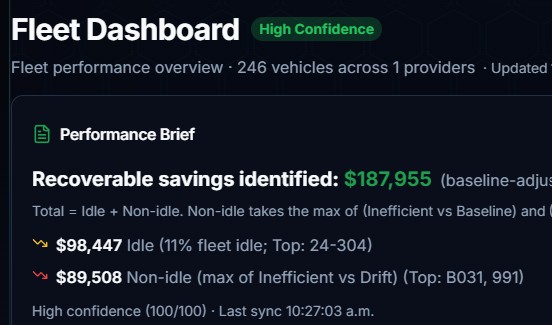
How Trucking Fleets Can Reduce Diesel Costs Without Adding New Hardware
Diesel is one of the largest operating costs in trucking. For many fleets, even a small improvement in fuel efficiency can have a major impact on profit.
The challenge is that diesel waste is not always obvious.
It may be hidden in idle time, underperforming trucks, poor asset utilization, maintenance issues, driver behavior, route patterns, or equipment that is slowly drifting from expected performance.
The good news is that most fleets already have the data they need to start finding those savings.
Start with the data you already have
Most fleets already use telematics. Systems like Samsara, Motive, Geotab, ISAAC, and other providers collect valuable operating data every day.
That data can show:
- fuel used
- distance travelled
- idle time
- engine hours
- vehicle activity
- driver behavior
- asset utilization
- route and duty-cycle patterns
The problem is not usually data collection.
The problem is turning that data into clear financial answers.
Fleet managers need to know which trucks are wasting fuel, how much it may be costing, and what should be investigated first.
Separate idle waste from operating waste
Idle time is one of the easiest fuel losses to see. Reducing unnecessary idle can lower fuel cost, reduce engine wear, and cut emissions.
But idle is only part of the issue.
Many fleets also lose fuel while trucks are moving. This non-idle waste can come from poor fuel economy, inefficient routes, maintenance issues, underperforming assets, or changes in how equipment is being used.
A fleet that only looks at idle may miss a large part of the savings opportunity.
The better approach is to separate fuel waste into clear categories:
- idle fuel waste
- non-idle fuel waste
- asset-level underperformance
- utilization issues
- efficiency drift over time
This makes it easier to know where the money is being lost.
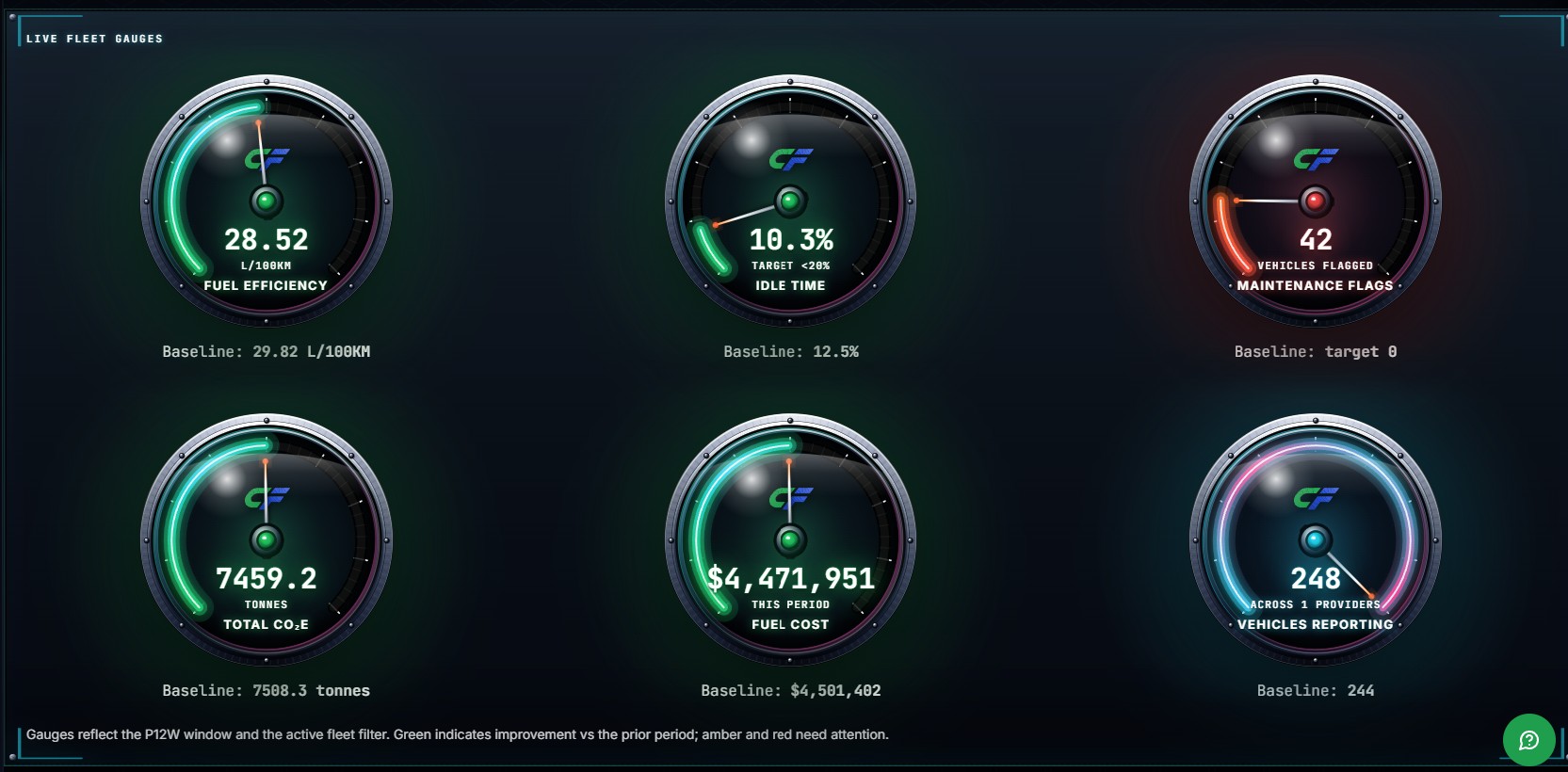
Benchmark trucks against a baseline
Fleet averages can hide expensive problems.
A fleet may appear to be performing normally while several trucks are quietly burning more fuel than expected. That is why asset-level benchmarking matters.
Each truck should be compared against its own historical performance, similar assets, and expected operating patterns.
This helps identify questions like:
Which trucks are performing worse than expected?
Which assets have drifted from their baseline?
Which vehicles should maintenance or operations review first?
Which issues are costing the most?
Once the fleet can rank these issues, management can focus on the highest-value opportunities first.
Turn fuel use into dollar values
Fuel reports are more useful when they are translated into dollars.
Litres, gallons, MPG, L/100 km, idle percentage, and engine hours are important, but management needs to understand financial impact.
The key question is:
How much money is recoverable?
When fuel waste is shown as a dollar value, it becomes easier to prioritize action. A fleet can decide whether an issue is worth investigating, whether a truck should be serviced, whether a driver needs coaching, or whether a route or duty cycle needs review.
Review fuel performance weekly
Annual fuel reviews are too slow.
If a truck is underperforming for three months, the fleet has already lost money. Fuel performance should be reviewed weekly so issues can be caught before they become long-term losses.
A weekly review should answer:
What changed?
Which trucks are getting worse?
Which trucks are improving?
Where is idle cost increasing?
Where is non-idle fuel waste increasing?
Which action should be taken first?
This turns fuel management into an active operating process instead of a year-end reporting exercise.
Use diesel reduction to improve emissions reporting
Reducing diesel use does more than lower cost. It also reduces Scope 1 emissions.
For trucking fleets, this is becoming more important as customers, shippers, and procurement teams ask for emissions information.
Every unnecessary liter or gallon of diesel burned increases emissions. When fleets reduce fuel waste, they can also show measurable emissions reductions.
That makes diesel cost reduction valuable for both profitability and sustainability reporting.
How CleanFreight helps
CleanFreight helps trucking fleets reduce diesel costs by analyzing existing telematics data and showing where fuel waste is hiding.
The platform helps identify:
- high-idling vehicles
- underperforming trucks
- non-idle fuel waste
- efficiency drift
- recoverable savings
- asset-level performance gaps
- Scope 1 emissions impact
CleanFreight does not replace telematics. It sits on top of telematics and turns the data into clearer fuel savings, emissions, and action reporting.
No new hardware is required.
Final takeaway
Trucking fleets can reduce diesel costs by using the data they already have more effectively.
The fastest path is to identify idle waste, non-idle fuel waste, underperforming assets, and efficiency drift before those problems continue for months.
CleanFreight in Canada and CleanFreight.io in the United States helps fleets find those savings faster by turning telematics data into clear, actionable fuel savings insights.
If your fleet already has telematics, the money may already be visible.
You just need the right layer of analysis to find it.
Free tool
Estimate your fleet's recoverable savings
Enter your fleet size and annual fuel spend to see what a 3%, 5%, and 8% recovery is worth for your operation.
One-time report
See what your own fleet is wasting
A Fleet Fuel Waste Assessment turns 12 months of your telematics data into one report: how much fuel is recoverable, where it goes, and the 10 trucks to fix first. CA$499, one time.
Join the platform and get CA$100 back. Subscribe to the CleanFreight platform within 30 days of your report and CA$100 of what you paid for the assessment comes off your first platform invoice.