
How CleanFreight Turns Telematics Data Into Fleet Fuel Savings
CleanFreight sits on top of telematics systems like Samsara, Motive, Geotab, and ISAAC to identify fuel waste, recoverable savings, asset performance gaps, and Scope 1 emissions opportunities.
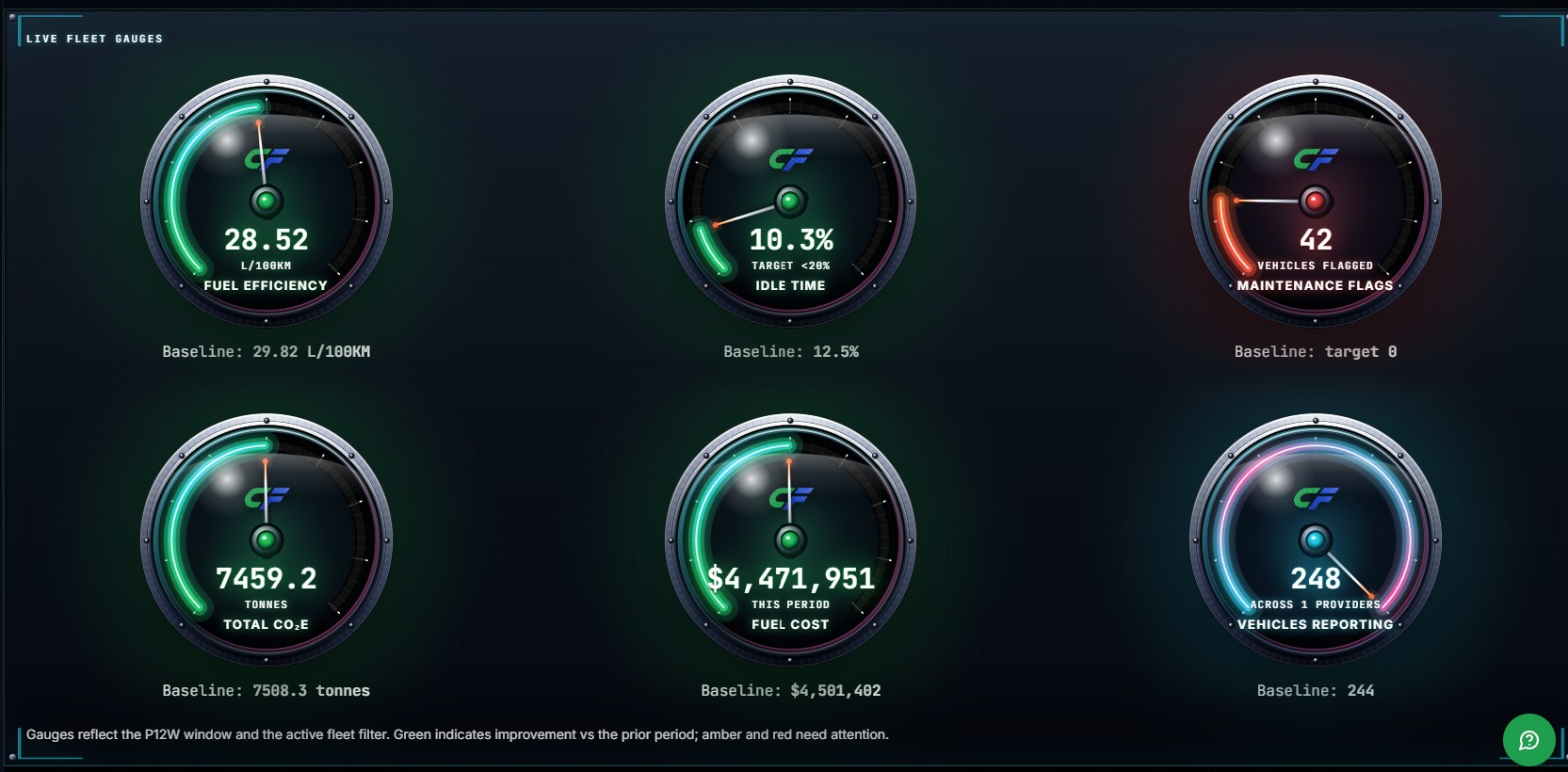
How CleanFreight Turbo-Charges Telematics Data Into Fuel Savings, Emissions Reporting, and Fleet Action
Your telematics system already captures the data. CleanFreight helps turn that data into recoverable savings.
Most trucking fleets already have a telematics system.
Samsara, Motive, Geotab, ISAAC, Omnitracs, PeopleNet, BlackBerry Radar, Verizon Connect, and other providers play an important role in modern fleet operations. They help fleets track vehicles, monitor activity, manage compliance, review idle time, support safety programs, and understand what is happening across the operation.
CleanFreight does not replace telematics.
CleanFreight sits on top of telematics.
The purpose is different.
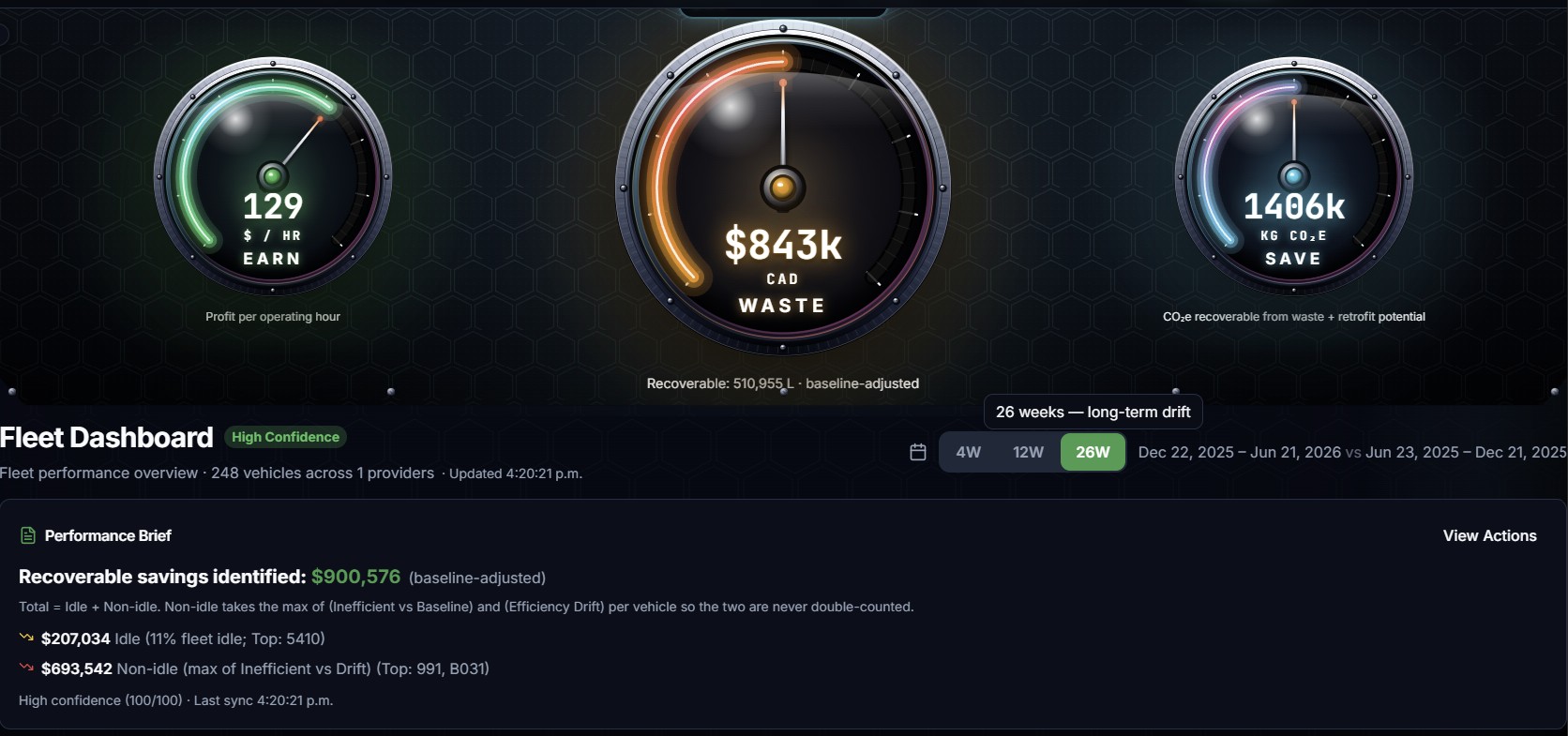
Telematics platforms are built to collect and display fleet operating data. CleanFreight is built to analyze that data differently, standardize it, compare it against fleet baselines, and show where fuel waste, asset performance gaps, emissions impact, and recoverable savings are hiding.
In simple terms:
Your telematics system shows what happened.
CleanFreight helps show what it cost, what changed, what can be recovered, and what should be investigated first.
Telematics is the foundation. CleanFreight is the performance layer.
A fleet cannot improve what it cannot measure. That is why telematics matters.
Telematics systems capture valuable operating information, including:
- Distance travelled
- Fuel consumed
- Engine hours
- Idle time
- Vehicle activity
- Location history
- Driver behavior
- Faults and maintenance signals
- Safety and compliance events
- Asset utilization
This data is essential.
But for many owners, CFOs, and operations leaders, the challenge is not whether the data exists. The challenge is finding the money inside the data.
That is where CleanFreight adds value.
Cleanfreight.ca takes telematics data and converts it into clearer business intelligence for fuel savings, operational efficiency, and emissions reporting.
Instead of requiring management to search through multiple dashboards, exports, spreadsheets, and reports, CleanFreight organizes the data around the questions fleet leaders care about most:
- Where are we wasting fuel?
- Which trucks are costing us the most?
- What is recoverable?
- What changed this week?
- What should we act on first?
- Did the corrective action work?
- How much CO₂e did we avoid?
- Can we prove performance improvements to customers, shippers, or internal stakeholders?
CleanFreight connects automatically to major telematics providers
CleanFreight automatically connects with four major telematics platforms:
Samsara, Motive, Geotab, and ISAAC.
For fleets using other telematics systems, CleanFreight can still connect manually using available data exports. That means CleanFreight can support fleets even when they are not using one of the primary automatic integration providers.
The goal is to make existing fleet data more useful, regardless of the system producing it.
Why telematics dashboards alone can leave savings behind
Telematics dashboards are powerful operational tools, but they are usually designed around system-specific views.
That means fleet managers often have to move between multiple screens to understand fuel performance, idle loss, vehicle-level efficiency, emissions, utilization, and trends.
This can create several problems:
- The data exists, but it is spread across different reports
- Fuel cost is often shown as usage, not recoverable savings
- Idle is visible, but non-idle fuel waste may be harder to isolate
- Truck-level performance may not be compared against a fair baseline
- Executive-level financial summaries may not be immediately available
- Emissions reporting may not be packaged for shippers or procurement requests
- Corrective actions may not be tracked through to verified results
- Multi-provider fleets may struggle with consistent reporting
None of this means the telematics platform is failing.
It means the data needs a second layer of analysis.
That is what Cleanfreight.ca provides.
CleanFreight helps fleets move from data review to action
One of the most important differences is workflow.
A traditional dashboard may show a manager that a truck has high idle, poor fuel economy, or unusual activity.
CleanFreight goes further by helping the fleet organize the issue into an action process.
CleanFreight can identify inefficient trucks, high-idling trucks, drift vehicles, and assets that exceed expected fuel cost or emissions thresholds. These issues can then be reviewed, assigned, investigated, dismissed, completed, or tracked with notes.
This matters because savings do not come from reports alone.
Savings come from action.
CleanFreight is designed to help fleets close the loop between insight and follow-through.
CleanFreight turns fuel data into recoverable savings
Fuel used is not the same as fuel wasted.
A truck may consume a large amount of fuel because it is working hard, running longer routes, or operating in difficult conditions. Another truck may consume less total fuel but still perform poorly against its expected baseline.
This is why CleanFreight focuses on recoverable fuel savings.
The platform compares actual performance against baseline expectations and helps estimate where fuel cost may be recoverable.
This allows fleets to move beyond basic consumption reporting and ask better questions:
- Did this truck use more fuel than expected?
- Is the issue related to idle time, operating efficiency, utilization, or another factor?
- How much money may be recoverable?
- Is this issue isolated to one truck, one group of trucks, one terminal, or the entire fleet?
- Is performance improving after action is taken?
This is where CleanFreight turns telematics data into financial visibility.
CleanFreight helps identify both idle and non-idle fuel waste
Idle time is one of the most common areas fleets monitor inside telematics systems.
That is useful, but idle is only one part of fuel waste.
CleanFreight also helps fleets look at non-idle fuel waste. This includes fuel lost while the truck is operating, not just sitting still.
Examples may include:
- Poor fuel efficiency compared to baseline
- Underperforming assets
- Unexpected fuel drift
- Trucks exceeding efficiency targets
- Units with abnormal fuel cost patterns
- Asset-level performance gaps
- Duty-cycle or utilization issues
For many fleets, this is where additional savings can be found.
A fleet may already be watching idle time but still missing performance losses that happen while trucks are moving.
CleanFreight gives management a clearer way to separate idle waste from broader fuel efficiency issues.
CleanFreight creates executive-level reporting from operational data
Fleet managers need operational detail.
Owners and CFOs need financial clarity.
CleanFreight is designed to serve both groups.
The platform converts telematics data into executive KPIs that are easier to act on, including:
- Fuel cost trends
- Recoverable savings
- Idle waste
- Non-idle fuel waste
- Asset-level profitability signals
- Best and worst performing vehicles
- Emissions against baseline
- Captured savings
- Remaining savings opportunity
- Verified CO₂e reductions
This gives leadership a clearer picture of what is happening without forcing them to dig through multiple telematics reports.
The result is a simpler management conversation:
Here is where money is being lost. Here is what changed. Here is what can be recovered. Here is what needs action first.
CleanFreight makes emissions reporting easier
Fuel waste and emissions are directly connected.
Every unnecessary litre or gallon of diesel burned increases Scope 1 emissions.
Many fleets now need to report emissions for customers, shippers, internal sustainability reviews, procurement responses, or public-facing performance claims.
Telematics platforms may show CO₂ data, but CleanFreight is designed to package emissions information into cleaner reporting outputs.
CleanFreight helps fleets track:
- Scope 1 tank-to-wheel emissions
- Emissions intensity
- CO₂e against baseline
- Verified emissions reductions
- Fuel savings connected to emissions savings
- Shipper-ready reporting appendices
- Sustainability reporting outputs
This is useful for fleets that need more than a number on a dashboard.
They need a report that can be understood by management, customers, and procurement teams.
CleanFreight helps prove whether improvements worked
One of the most overlooked parts of fleet efficiency is verification.
It is not enough to identify a fuel issue.
The fleet needs to know whether the action taken actually improved performance.
CleanFreight supports this by helping fleets track outcomes after an issue has been investigated or corrected.
This gives management a more complete view:
- What was the issue?
- Who investigated it?
- What action was taken?
- What changed afterward?
- Did savings improve?
- Did emissions decrease?
- Is the issue resolved or still active?
This is where fuel savings become measurable operational improvement instead of a one-time report.
CleanFreight standardizes reporting across providers
Many fleets use one telematics system. Some fleets use more than one.
This can happen because of acquisitions, mixed equipment, customer requirements, legacy systems, owner-operator arrangements, or regional operating differences.
When multiple systems are involved, reporting can become inconsistent.
CleanFreight helps standardize reporting across supported providers by organizing data into common performance categories and KPIs.
That gives management one cleaner view of:
- Fleet performance
- Fuel savings opportunities
- Asset-level issues
- Idle and non-idle waste
- Emissions performance
- Terminal or group-level scorecards
- Executive and operational reporting
For growing fleets, this kind of standardization becomes more valuable over time.
What CleanFreight does not replace
CleanFreight is not trying to replace the core functions of telematics.
Telematics providers are strong in areas such as:
- GPS tracking
- ELD and HOS compliance
- Driver logs
- Cameras and safety events
- In-cab hardware
- Dispatch visibility
- Device management
- Real-time vehicle monitoring
- Maintenance alerts
- Driver-facing tools
That is their world.
CleanFreight focuses on a different problem:
How do we turn fleet data into fuel savings, emissions reporting, asset performance insights, and management action?
That distinction matters.
The best setup is not telematics or CleanFreight.
The best setup is telematics plus CleanFreight.
The real value: finding the money faster
Most fleets already have the raw data.
The problem is time.
Fleet managers do not have unlimited hours to export reports, compare trucks manually, calculate baselines, build spreadsheets, investigate anomalies, and prepare executive summaries.
CleanFreight shortens that process.
It helps fleets quickly see:
- Which trucks are inefficient
- Which trucks are idling too much
- Which assets are drifting from expected performance
- Where recoverable fuel dollars remain
- How much savings has already been captured
- How emissions are changing
- Which issues need action first
That is why CleanFreight is best understood as a fuel savings and emissions intelligence layer on top of telematics.
It helps fleets get more value from systems they already use.
Final takeaway
Telematics systems are essential.
They collect the data fleets need to operate safely, efficiently, and compliantly.
CleanFreight makes that data more actionable.
By connecting to telematics systems like Samsara, Motive, Geotab, and ISAAC — and supporting manual connections for other systems — CleanFreight helps fleets turn existing data into recoverable savings, executive reporting, asset-level insights, and Scope 1 emissions visibility.
The result is not a replacement for telematics.
It is telematics on steroids.
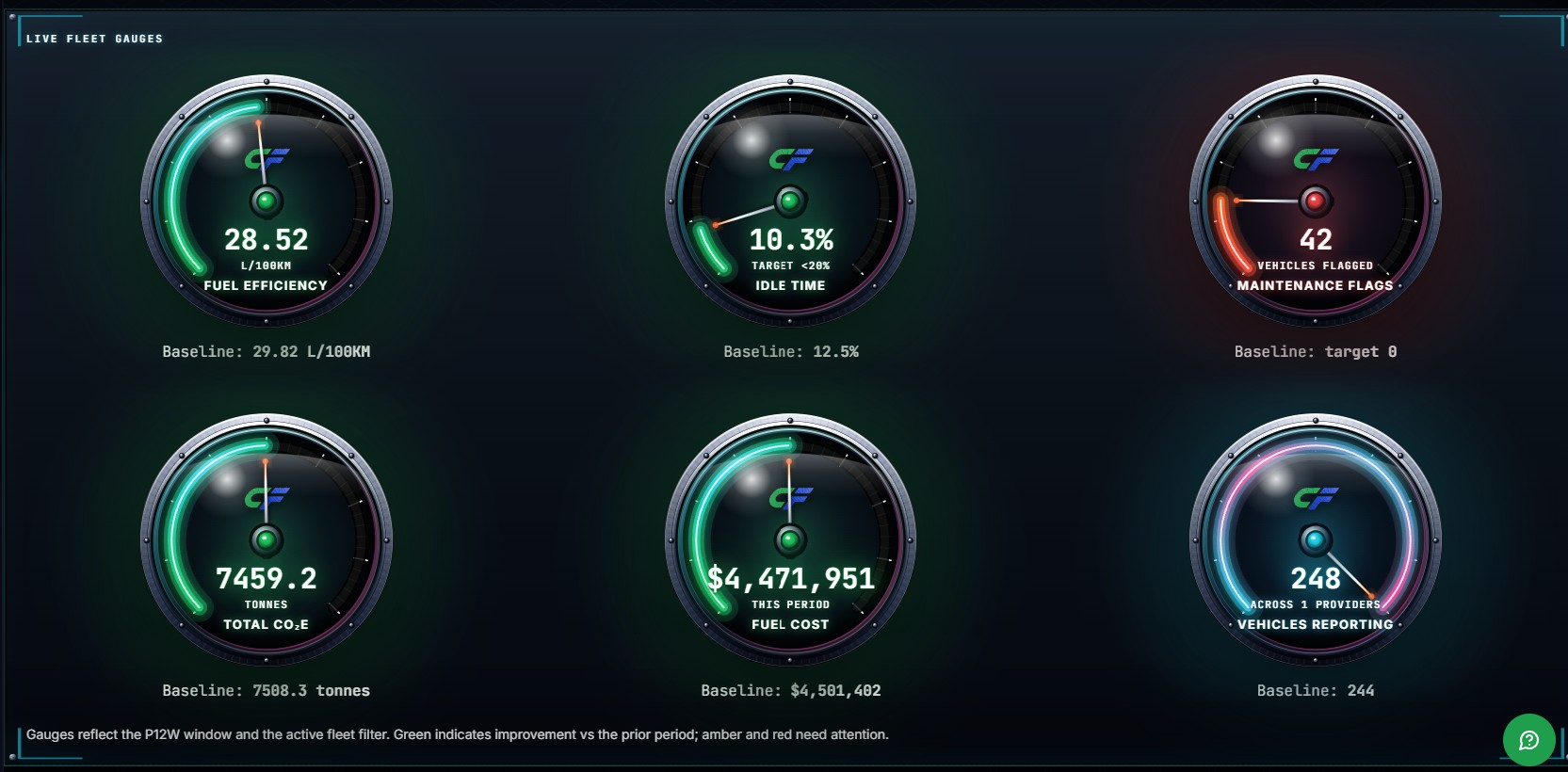
More specifically, it is a performance layer that helps fleets find the money, assign the action, verify the result, and report the outcome.
Ready to get more value from your telematics data?
CleanFreight helps trucking fleets identify fuel waste, recoverable savings, asset performance gaps, and Scope 1 emissions opportunities using the data they already have.
If your fleet already uses telematics, CleanFreight can help show where the money is hiding.
Visit Cleanfreight.ca or Cleanfreight.io to learn more.
One-time report
See what your own fleet is wasting
A Fleet Fuel Waste Assessment turns 12 months of your telematics data into one report: how much fuel is recoverable, where it goes, and the 10 trucks to fix first. CA$499, one time.
Join the platform and get CA$100 back. Subscribe to the CleanFreight platform within 30 days of your report and CA$100 of what you paid for the assessment comes off your first platform invoice.